
Picture your morning routine: you brush your teeth with Crest, wash your hair with Head & Shoulders, throw a load of wash in with a Tide Pod, then hand wash your dishes with Dawn. What do all these products have in common? They’re all owned by Procter & Gamble. Though they appear as separate, distinct brands, they all live under the same corporate roof.
Or think about your last visit to a theme park. You went to Six Flags, rode coasters with unique names, visited food stands with fun local branding—and maybe never once saw the corporate Six Flags logo. That, too, is brand architecture at play.
Understanding this hidden framework can be eye-opening, especially when you’re leading a business or nonprofit with multiple products, services, or initiatives. The way you structure your brand impacts everything—from how people find you, to how they trust you, to how efficiently your team operates.
Let’s explore what brand architecture is, why it matters, and how you can use it to your strategic advantage.
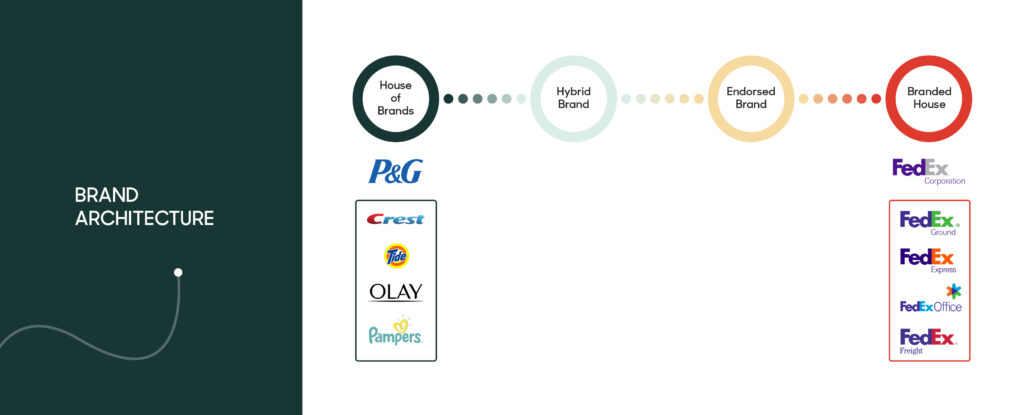
A clear and compelling brand structure is essential for connecting your audience to your business or organization’s story, ensuring discoverability, and providing clarity on your offerings. Brand architecture helps organizations define relationships between different brands within the same company, allowing for a strategic approach to marketing, positioning, and operations. Traditionally, brand structures exist on a spectrum between two extremes: the House of Brands and the Branded House. Let’s explore them.

The Spectrum of Brand Architecture
House of Brands
A House of Brands strategy treats each brand as a distinct entity with its own identity, audience, and messaging. Parent companies remain in the background while sub-brands operate independently. This is commonly used when brands serve different markets or when differentiation is key. Example: Procter & Gamble (P&G) owns Tide, Gillette, Pampers, and other household names, each with its own branding and audience.
Branded House
A Branded House uses a single master brand across all offerings, creating a unified identity and reinforcing the brand’s core message. This structure provides clarity and efficiency in marketing and operations.
Example: FedEx follows a Branded House approach, with FedEx Ground, FedEx Express, and FedEx Office all falling under the Google brand.
Hybrid Brands
A Hybrid Brand strategy blends aspects of the House of Brands and the Branded House. Some sub-brands are given strong individual identities, while others maintain a clear connection to the parent brand.
Example: Six Flags operates theme parks under one umbrella brand but allows for localized park names and individual attractions to carry unique branding.






Endorsed Brands
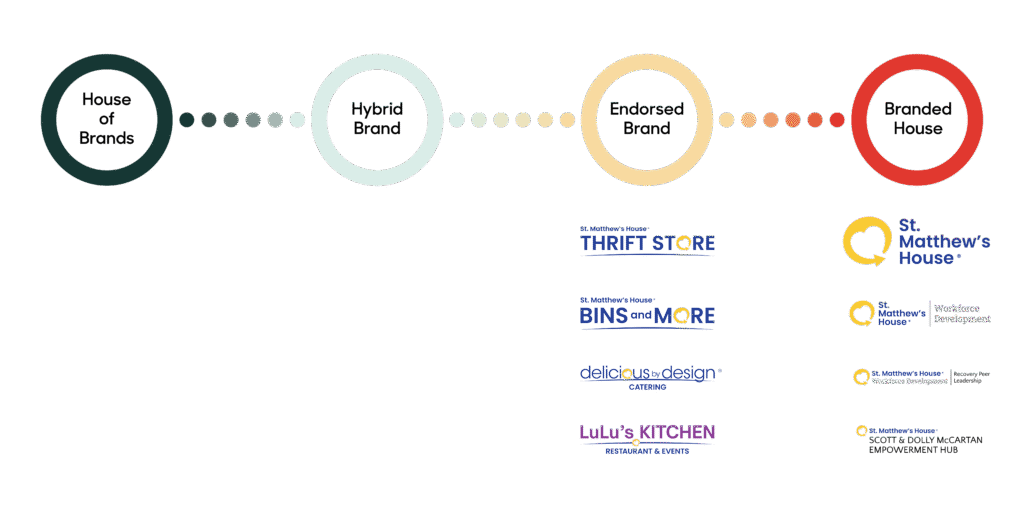
An Endorsed Brand retains its distinct identity but benefits from the credibility and backing of the parent brand. The endorsement builds trust while allowing sub-brands to maintain some independence.
Example: St. Matthew’s House has various entities like Lulu’s Kitchen and Delicious by Design, which have their own branding but are endorsed by St. Matthew’s House to maintain trust and recognition among donors.
Why Brand Architecture Is Crucial—for Clarity, Alignment, and Growth
Brand architecture isn’t just a marketing decision—it’s a strategic foundation that shapes how people understand your organization and how your team operates within it.
A well-defined structure brings clarity of identity, ensuring each brand or sub-brand is positioned correctly in the market. Without it, audiences may struggle to understand your offerings or distinguish between services. Internally, misalignment creates inefficiencies, diluted messaging, and confusion for staff, donors, and partners alike.
But the impact goes even deeper. A clear brand architecture also influences internal culture, decision-making, and strategic planning. When the role of each brand is clearly defined, organizations can make better decisions around.
- Marketing & Messaging: Maintaining consistency across platforms and touch points.
- Operational Processes: Structuring teams, resources, and workflows in a more integrated way.
- Strategic Growth: Evaluating how new initiatives fit within the existing framework.
In short, brand architecture isn’t just about how your brand looks—it’s about how your organization functions and grows with clarity and confidence. An example of this is in our work with St. Matthew’s House.
Case Study: St. Matthew’s House
When we first began working with St. Matthew’s House (SMH), one of our initial steps was understanding how the organization perceived itself—and how the outside world perceived it. The gap was significant. Everyone agreed that SMH did “a lot of good,” but even internal staff struggled to list all the programs and services they offered.
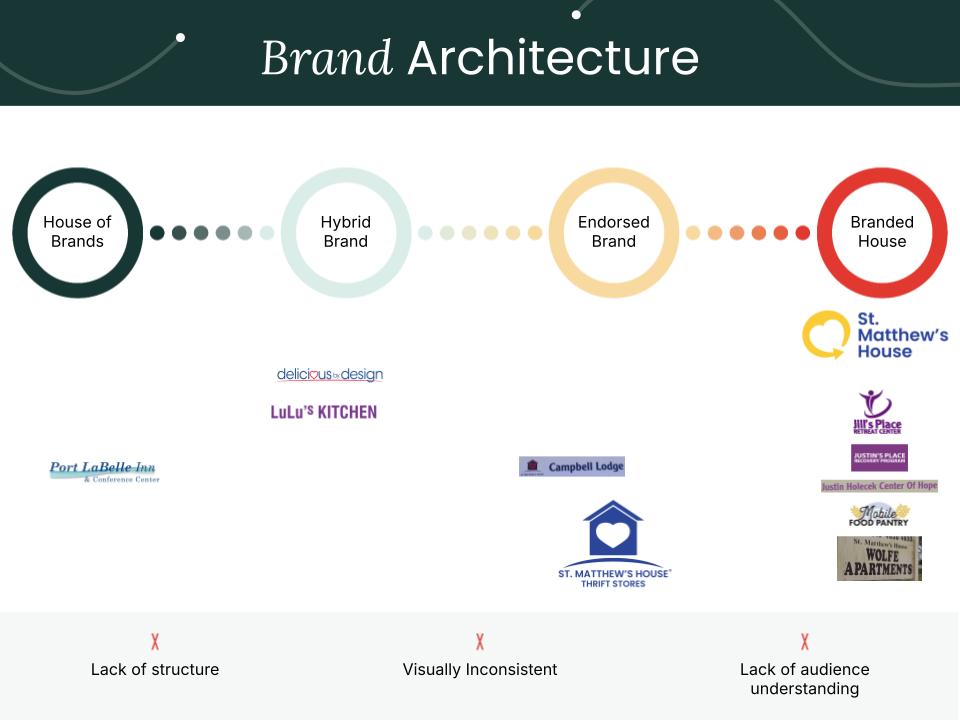
The brand experience was fragmented. On social media and their website, thrift stores were often more prominent than the organization itself. Visually, each sub-brand had its own design system and marketing materials—essentially operating as independent marketing departments. Although SMH had technically distinguished between their social enterprises and programs, the execution was inconsistent and contributed to brand confusion both internally and externally.
There was initial debate around whether SMH should pursue a House of Brands or Branded House strategy. While the rationale behind the House of Brands approach was considered, we ultimately landed on a hybrid structure that included a Branded House model for SMH’s core programs and Endorsed Brands for its social enterprises.
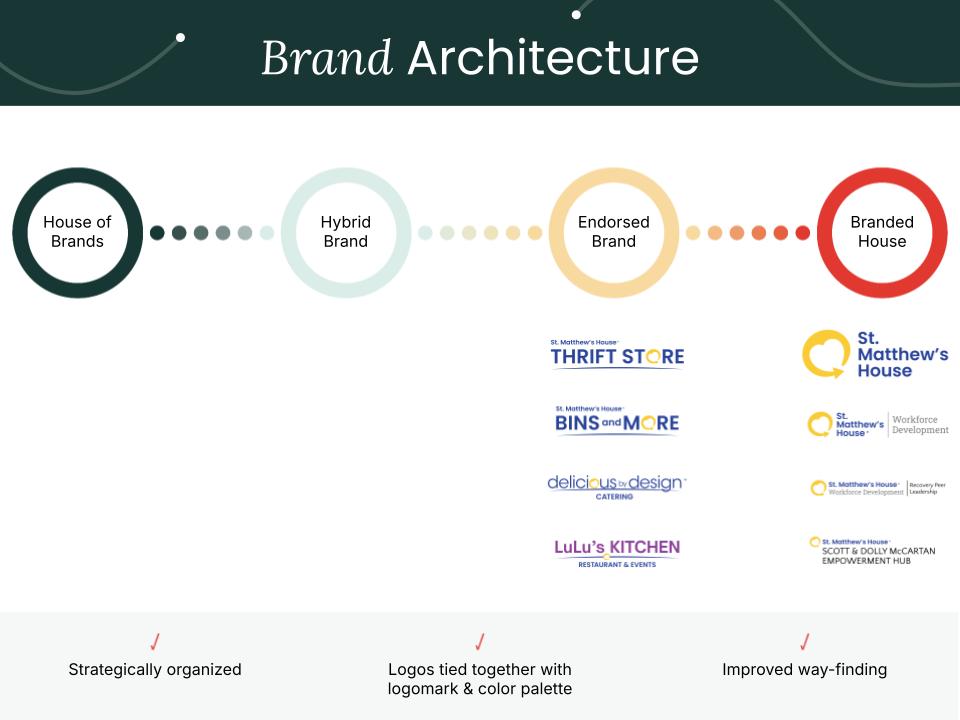
This structure allowed us to bring clarity and cohesion. For the core brand and its programs, we designed a bold, recognizable logomark that is now prominently displayed—making it immediately clear when something is part of SMH. For the social enterprises like Lulu’s Kitchen and Delicious by Design, the SMH mark is included more subtly, as a secondary element, such as the “o” in a wordmark or a smaller icon. This maintains the unique identity of each enterprise while still reinforcing their connection to the parent organization.
Why was this important? Because brand clarity drives trust, donor confidence, and operational efficiency. SMH is a large, multifaceted organization. Making it easy for the public to understand what they do—and who they are—was essential. A strong, unified brand system also created internal alignment and allowed the organization to operate with greater confidence and professionalism. They’ve shared that with their new structure and visual identity, they feel more cohesive, confident, and capable when representing themselves at events and in the community.
Brand architecture was more than just a design project—it was a strategic shift that has transformed how SMH tells its story and serves its mission.
Choosing the right brand architecture is not just about branding—it’s about aligning an organization’s strategic vision, operations, and audience perception. Whether opting for a House of Brands, Branded House, or a Hybrid approach, a well-structured brand strategy ensures clarity, strengthens connections, and drives long-term success.